

Scaling MSP Success with the Self-service portal
Magnus Thunberg Interviews Thomas Bak, CEO of Auwau
Europe's digital economy is powered by small and medium-sized businesses. In many European countries, more than 99% of companies employ fewer than 300 people. Behind the success of these organizations are Managed Service Providers (MSPs) that deliver secure, reliable, and cost-effective IT services every day.
At Cristie, we believe MSPs are a critical part of Europe's digital infrastructure, and we want to celebrate the fantastic work they do. To discuss how MSPs can scale profitably while delivering world-class services, Magnus Thunberg from Cristie sat down with Thomas Bak, CEO of Auwau.
Executive Summary
The Self-service portal enables MSPs to become more scalable, profitable, secure, and customer-centric by combining automation, self-service, billing automation, multi-tenancy, and multi-vendor management in a single platform. Combined with Cristie S3-2-Tape, it also opens new recurring revenue streams through archive and immutable storage services.
Welcome Thomas!
"Magnus Thunberg, Cristie
Thomas, it's great to have you here. Thank you for taking the time to speak with us. It´s great to see you as always!”
Many MSPs are looking for ways to scale their businesses efficiently while managing hundreds or even thousands of small and medium-sized customers. I would love to hear your perspective on how technology can help MSPs remain both successful and profitable.
"Thomas Bak, Auwau
Thank you, Magnus. It's always a pleasure to be here and discuss the challenges and opportunities that MSPs face today. And we are happy you are using our technology in your portal!”
Why Was the Self-service portal Created?
Magnus: Many MSPs are facing increasing pressure to do more with fewer resources. Why was the Self-service portal developed in the first place?
Thomas: The reality is that most MSPs eventually reach an operational scaling challenge. As the number of customers grows, so does the administrative workload. More billing, more support requests, more users, more reporting, and greater complexity.
The Self-service portal was designed specifically to solve this problem. By automating routine processes and enabling customer self-service, MSPs can significantly increase service capacity without having to expand their administrative teams at the same rate.
In short, it allows providers to grow revenue faster than operational costs.
Multi-Tenancy and Business Growth
Magnus: One feature that frequently comes up in customer discussions is multi-tenancy. Why is it so important?
Thomas: Because MSP organizations are rarely simple. Providers often work with distributors, resellers, customers, departments, business units, and project organizations that all require different levels of visibility and access.
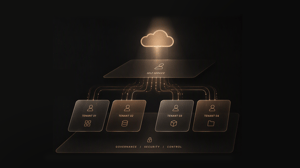
The Self-service portal enables MSPs to build a complete business hierarchy that mirrors their real-world organization. Customers remain securely separated while the provider maintains centralized management across the entire platform.
This flexibility becomes essential when managing hundreds or even thousands of organizations.
Magnus: So it's about much more than technical separation?
Thomas: Exactly. It's also about business separation. Every customer only sees their own services, reports, data, and usage information, while the MSP retains full operational control.
Self-Service Reduces Operational Costs
Magnus: Let's talk about self-service. Why should MSPs allow customers to manage parts of the platform themselves?
Thomas: Because every support ticket has a cost.
With the Self-service portal, customers can perform many daily tasks independently. They can access reports, review service usage, manage users, provision services, create S3 buckets, and monitor their environments without requiring intervention from the MSP.
The result is a win-win situation. Customers receive faster service while providers improve efficiency and profitability.
Security, Compliance, and Delegated Access
Magnus: Security is becoming increasingly important, especially with regulations such as NIS2 and DORA. How does the portal support compliance requirements?
Thomas: The platform was designed around secure delegation.
It supports Role-Based Access Control (RBAC), allowing MSPs to provide the right permissions to the right people. In addition, the portal supports Single Sign-On (SSO), Multi-Factor Authentication (MFA), detailed audit logging, and segregation of duties.
Organizations can therefore empower users while maintaining full control and governance.
Billing Automation Drives Profitability
Magnus: One of the strongest MSP use cases I see is billing automation. Why is that capability so valuable?
Thomas: Because recurring billing is often a hidden operational cost.
The Self-service portal automatically tracks consumption across tenants, customers, departments, and business units. Billing information can then be exported through CSV, JSON, or REST APIs and integrated into existing business systems.
Instead of spending days preparing monthly invoices, MSPs can automate most of the process, reducing costs, increasing accuracy, and improving profitability.
Magnus: So MSPs can build true pay-per-use business models?
Thomas: Absolutely. The platform was built specifically to support subscription-based and consumption-based services.
Reporting and Customer Transparency
Magnus: Customers increasingly expect transparency. How does reporting support that?
Thomas: Reporting is one of the most appreciated features.
Customers gain access to historical usage, service status, trends, capacity consumption, and other key operational metrics. Reports and alerts can also be scheduled and delivered automatically.
This level of transparency strengthens customer trust while eliminating manual reporting effort for the MSP.
Managing Multiple Backup Technologies
Magnus: Many service providers support multiple backup platforms. How does the portal simplify administration?
Thomas: Rather than forcing administrators to work across several management interfaces, the Self-service portal acts as a centralized management layer.
Today it supports technologies including:
-
IBM Storage Protect
-
IBM Storage Defender Data Protect
-
IBM Cloud Object Storage
-
Rubrik
-
Cohesity
-
Cristie S3-2-Tape
- CommVault
This creates a consistent user experience and significantly reduces operational complexity.
Introducing Cristie S3-2-Tape
Magnus: One of the most exciting developments is the integration of Cristie S3-2-Tape. What does this mean for MSPs?
Thomas: Cristie S3-2-Tape extends the portal with tape-backed object storage services.
Through the integration of S3-2-tape technology into the Self-service portal, MSPs can now offer long-term archive services while maintaining the same multi-tenant management experience their customers already know.
Customers can create buckets, manage permissions, and consume archive services through the portal while the storage lifecycle is managed automatically in the background.
Creating New Revenue Streams
Magnus: What business opportunities does this create?
Thomas: A very significant opportunity.
MSPs can now offer a highly cost-efficient archive tier similar to Glacier-style services, but backed by tape technology.
Tape also provides an immutable storage layer that supports cyber resilience, regulatory compliance, and long-term retention requirements. Combined with automated billing and customer self-service, it creates a highly scalable Archive-as-a-Service offering.
Partner Label and Partner Enablement
Magnus: Many of our partners want to strengthen their own brand identity. How does the platform support that?
Thomas: The portal offers extensive partner-label capabilities.
MSPs, distributors, and resellers can apply their own branding, logos, and color schemes to create a fully branded customer experience while Cristie delivers the underlying technology and expertise.
This helps partners strengthen customer relationships and increase brand visibility.
Final Thoughts
Magnus: If you had one message for MSPs considering a transformation of their managed services business, what would it be?
Thomas: Focus on automation and customer empowerment.
The most successful MSPs over the next few years will be those that combine scalability, profitability, security, and self-service. The Self-service portal was designed specifically to help service providers achieve exactly that while opening new revenue opportunities through technologies such as Cristie S3-2-Tape.
Magnus: Thank you, Thomas!
It is clear that the combination of the Self-service portal and Cristie S3-2-Tape provides MSPs with a powerful platform for delivering modern backup, recovery, object storage, and archive services efficiently, securely, and profitably.
Key Takeaways for MSPs
-
Multi-tenancy and reseller hierarchies
-
Customer self-service capabilities
-
Role-Based Access Control (RBAC)
-
Single Sign-On (SSO) and Multi-Factor Authentication (MFA)
-
Automated recurring billing
-
Consumption tracking and chargeback capabilities
-
Reporting, alerts, and scheduled reporting
-
Centralized administration
-
REST API integration
-
White-label branding
-
Multi-vendor backup management
-
Audit logging and compliance support
-
Cristie S3-2-Tape archive services
-
Improved scalability and operational efficiency